India’s EVs under Dragon’s shadow
Our petroleum supplies are impacted by the Strait of Hormuz blockade. Perhaps that could explain the growth of EV sales in India, doubling from last year. While EVs are fun to drive and economical, I thought of doing little bit of research on how dependent we are on China. ie., If the supply chain from China is blocked, what will happen to industry and existing owners?
TL;DR - Industry comes to a grinding halt!
Battery
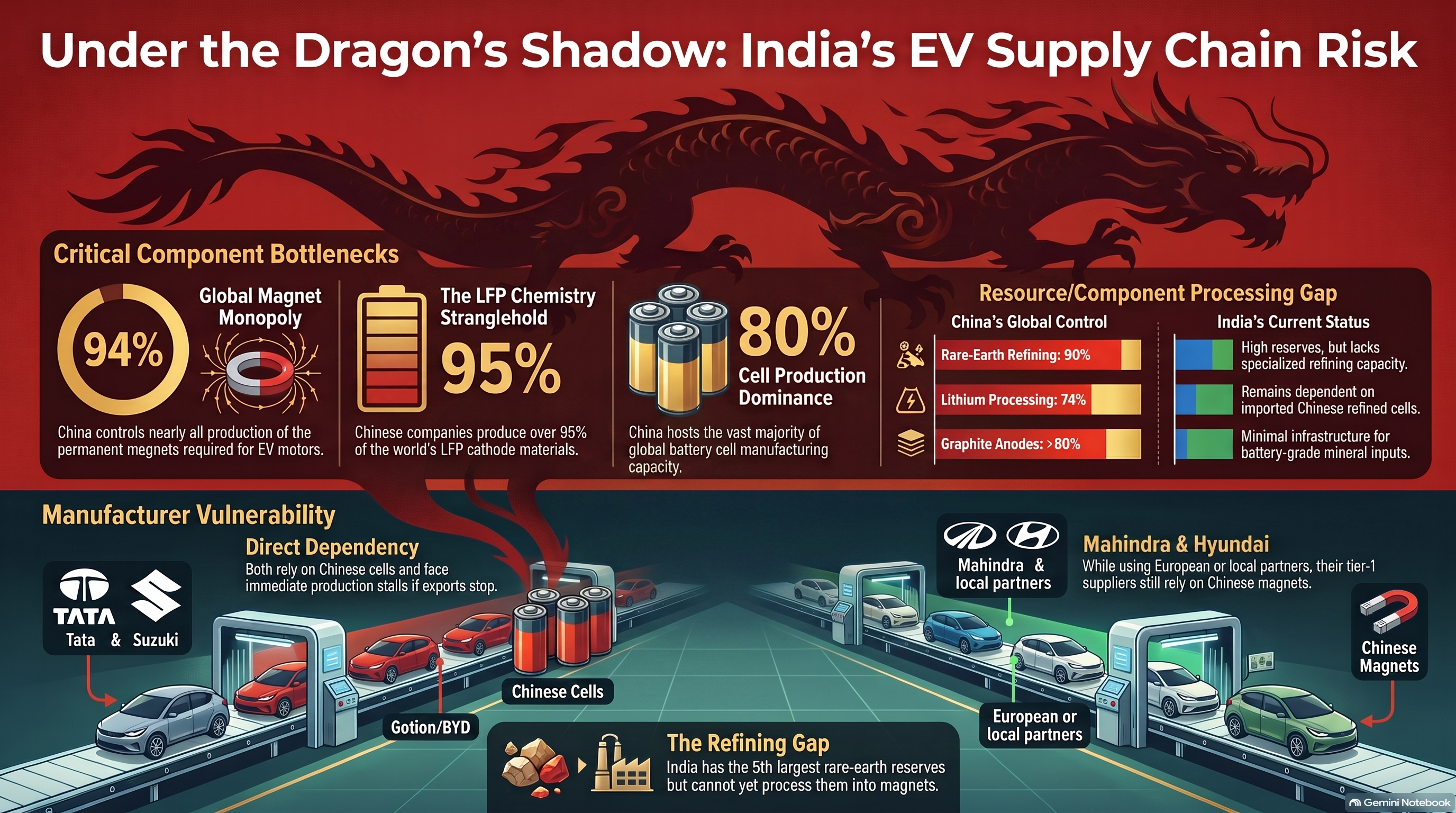
Almost every Indian manufacturer imports cells from China that go into your battery pack. Some of them import entire battery packs. Suzuki has a manufacturing plant in Gujarat, while Hyundai/Kia has signed a partnership with Exide and Tata Motors have their own research into LFP cells. Clearly, Suzuki is ahead.
The process for manufacturing cells can be split into three streams.
- Upstream - raw materials. Lithium extraction is available in Australia, Chile, Bolivia and Argentina. However, to process it, ultra high purity purified phosphoric acid (PPA) is needed. While mining phosphate rock is globally distributed, purifying it to battery grade PPA is all in China.
- Midstream - processing & manufacturing. China holds an absolute market bottleneck across the processing and manufacturing steps of the LFP supply chain.
- Cathode Active Material (CAM): Chinese companies produce over 95% of the world’s LFP cathode material. Emerging non-Chinese alternatives, such as L&F Plus in South Korea, are only just initiating localized production.
- Refining and Anodes: China processes roughly 74% of global lithium and controls over 80% of the synthetic and natural graphite anode supply.
- Cell Manufacturing: Over 80% of all global battery cell production capacity resides within China). Dominant industrial leaders like CATL and BYD command the global deployment curve.
- Downstream - assembly of battery packs.
- India: Despite aggressive domestic incentives like the Production Linked Incentive (PLI) scheme, India’s mineral refining infrastructure for battery-grade inputs remains minimal, maintaining a downstream dependency on imported Chinese cells.
- North America and Europe: While Gigafactories are expanding across these regions, they rely heavily on imported Chinese components, cathode precursors, and refined minerals. This makes them vulnerable to maritime shipping delays and evolving trade barriers.
Motor
EV grade motors are Permanent Magnet Synchronous Motors (PMSM). These require permanent magnets which in turn require critical rare-earth elements - specifically neodymium, dysprosium, and praseodymium - to function. India imported 85% of permanent magnets from China, approximately worth US$ 200 million.
While India possesses the world’s fifth-largest natural reserves of rare-earth ores, it lacks the specialized industrial capacity to refine these ores into battery/motor-grade materials and press them into high-performance magnets. China maintains a near-monopoly, controlling over 90% of global rare-earth refining and 94% of permanent magnet production.
Electronics
Sourcing of CPUs and memory chips is heavily dependent on Taiwan. Displays for infotainment and digital meters are imported from China, South Korea and Japan. Sub-components assembly and sourcing is usually from hubs in Taiwan and Vietnam.
Supply chain for battery management systems is similar.
Near Term Effect of Supply Chain Disruption
So what happens if ships stop coming from China?
- Battery supply stops
- Motor manufacturing stops
- Electronics stops (we can still go back to simple, non-distracting analogue clusters!)
Details distilled by Google Gemini based on sources collected below. Other EV manufacturers like MG, BYD (both are based out of China), Vinfast (too new to India) aren’t considered.
| Manufacturer | Cell & Battery Supply Chain Dependencies | Vulnerability to Chinese Cell/Mineral Export Blockade | Motor & Powertrain Supply Chain Dependencies | Vulnerability to Chinese Rare-Earth / Motor Component Blockade |
|---|---|---|---|---|
| Tata Motors | Uses LFP chemistry battery packs. Sources prismatic cells from Gotion (China) via Tata AutoComp and cylindrical cells from EVE Energy (China) via Octillion Power Systems. Agratas (Tata’s battery unit) is developing in-house LFP cell tech at a pilot line in Sanand to seek self-sufficiency. | Severe short-term risk While Agratas is localizing cell manufacturing, India severely lacks the chemical/mineral refining infrastructure required for precursor materials. Tata remains dependent on China for LFP cathode active materials, processed lithium (China refined 74% globally), and graphite anode materials (China controls >80%). | Uses PMSM (Permanent Magnet Synchronous Motors) Motor assemblies and controllers are developed in-house or in collaboration with Tata AutoComp. | Critical bottleneck PMSM motors require critical rare-earth permanent magnets (neodymium, dysprosium, praseodymium). China controls 90% of global rare-earth refining and 94% of magnet production. India imports roughly 85% of its permanent magnets from China, meaning Tata’s local motor production would stall immediately. |
| Suzuki (Maruti Suzuki) | e Vitara utilizes LFP blade cell batteries sourced from BYD (China) via FinDreams Battery. | Absolute short-term vulnerability A Chinese cell export embargo would completely halt Suzuki’s upcoming BEV rollouts, till the factory in Gujarat is fully operational. | Adopts a localized eAxle developed by BluE Nexus (Aisin, Denso, Toyota) and manufactured in India. | High risk Despite localizing the physical eAxle assembly in India, the core PMSM traction motor is structurally dependent on Chinese rare-earth permanent magnets. A China export block would starve Suzuki’s localized JV of these critical elements. |
| Mahindra | Sources LFP blade cells (60kWh/80kWh) from BYD (China) for its INGLO-based BE.6 and XEV 9e.< Sourced NMC cells from Farasis Energy (China) for the XUV400. Sourcing deal with Volkswagen for unified LFP cells is delayed until 2026–2027. | High short-term vulnerability Because BYD imports all cells from China, Mahindra is exposed to immediate cell shortages. An export blockade before the delayed VW unified cell supply chain becomes active in 2026–2027 would halt Mahindra’s premium EV pipeline. | Sources integrated 3-in-1 electric powertrains (inverter, transmission, motor) from Valeo (France). Adapting Volkswagen’s APP550 rear electric motor for the INGLO platform. | Indirect but severe risk While Mahindra relies on European Tier-1 suppliers (Valeo and VW), those global suppliers are still exposed to China’s 94% monopoly on permanent magnet production, causing downstream supply delays. |
| Hyundai & Kia | Both brands historically used imported NMC chemistry battery packs from LG Chem and SK Innovation. Signed an MOU in April 2024 with Exide Energy Solutions to localize LFP cell production in India. | High mid-to-long-term risk Localizing LFP cell assembly in India with Exide is an effective buffer. However, the precursor chemistry remains highly vulnerable; China processes over 95% of LFP cathode materials and dominates battery-grade Purified Phosphoric Acid (PPA) refining, meaning Exide’s local factory would lack raw chemical feedstocks. | Rely on high-efficiency PMSM motors for mainstream vehicles (e.g., Creta EV, Carens Clavis EV). | Critical bottleneck Like their peers, Hyundai and Kia’s localized models rely on PMSM tech. Any restrictions on rare-earth magnets from China would create a 20% to 30% cost disadvantage or halt motor deliveries entirely due to the absence of domestic refining capacity. |
Supply Chain Disruption 5-8 years later
EV Motors last 15-20 years and 300,000km. They are believed to outlast petrol/diesel (Internal Combustion Engines - ICE) engines due to far fewer moving parts. They will certainly outlast batteries.
When EV batteries deteriorate to the point where it can’t be charged or used for practical applications, these can be recycled. Cells can be extracted, lithium can be extracted etc to create new battery packs. Recycling can be done multiple times before they become useless.
India has facilities that already do this. These need to be scaled up and processes for recycling made easier and tightened. It will be very bad for environment to see battery packs in landfills.